Album Review: Gorillaz - 'The Mountain'
25 years of Gorillaz, and they’re still reaching new heights. The stunning, globetrotting world of their ninth album The Mountain is a moving, culturally and musically rich confrontation of death, and one of 2026’s best releases so far.
The first words we hear on The Mountain are those of late American actor and filmmaker Dennis Hopper uttering the album’s title, resampled from the outtakes of his spoken word vocals on ‘Fire Coming Out Of The Monkey’s Head’, the thirteenth track from 2005’s Demon Days.
At once, two of the album’s main motifs establish themselves: Gorillaz’ transformative journey over the past two-and-a-half decades up to today, along with a stark confrontation of mortality, death, and loss. Hopper is the first of six features from departed musicians across The Mountain, bringing death and the timelessness quality of music into sharp focus through our headphones and speakers. The personal nature of the album’s grappling with mortality also owes to both Damon Albarn and Jamie Hewlett’s experiences of loss and grief in recent years. Both lost their fathers within the space of ten days in 2024, and it was on the banks of the Ganges in the ancient Indian city of Varanasi that Albarn later scattered his late father’s ashes. The preceding year, Hewlett’s mother-in-law suffered a stroke whilst in Jaipur with Hewlett and his wife, and never recovered. “There’s no better place to come to terms with death than India,” Hewlett reflects. “In the West, death is final. Whereas in India, the sadness comes from knowing that you won’t be able to see that family member in this form, but we celebrate the idea that they’re going to start again.”
‘The Hardest Thing’ strikes to the core of life’s end. Opening with Yoruba spoken word from the late, great drummer Tony Allen, a frequent collaborator of Albarn’s who drummed with and directed Fela Kuti’s band in the 70s, we hear “Oya E Dide Erori” repeated three times. Translated as “We are ready (let’s go)”, Albarn’s piercing words follow: “You know the hardest thing is to say goodbye to someone you love”. Repeating the same lyric at the start of the next track ‘Orange County’, his stark honesty continues, finally repeating “I don’t know if I can take this anymore / So why are you trying to break me?” A track grounded by the humanity of its repeating whistling melody and the warm, disarming vocal interjections of American musician and poet Kara Jackson, it’s perhaps Albarn at his most vulnerable ever.
The Mountain blends this real-world emotional darkness with the virtual reality inhabited by 2-D, Noodle, Murdoch and Russel, alongside reflecting the existential politics of our time. The forcible joy of ‘The Happy Dictator’ was shaped by Albarn’s experiences in Turkmenistan and North Korea, as well as the lies of Trumpian America. ‘The God of Lying’, featuring British post-punk band IDLES, similarly critiques our post-truth world. Joe Talbot’s questioning opening reveals a concoction of real-world concerns: “Are you happy with your housing? Are you climbing up the walls? Are you deafened by the headlines? Or does your head not hear at all?” Oscillating between Talbot’s sullen commentary and Albarn’s escapist chorus, the tune straddles the mythical world of The Mountain and our reality. Singing from the perspective of The God of Lying in the second verse, the IDLES vocalist croons:
“Do you love your blessed father? Anoint by fear of death
Do you feel the lies creep on by? As soft as baby’s breath
Do you beg that truth will set you free? Are you shackled by the keys?
Well if I was you, I’d stay strapped in, cos’ all you’ve got is me.”
The Mountain certainly delivers on the multidimensionality that Gorillaz are known for, layering the virtual with the real, and particularly the global. Featuring five languages and musicians from five continents, the album was recorded between London, Devon, Mumbai, New Delhi, Rajasthan, Varanasi, Ashgabat, Damascus, Miami and New York. Immensely talented Indian musicians feature across much of the album, and the very first sounds we hear on The Mountain’s opening title track are the flowing melodies of Ajay Prasanna’s bansuri bamboo flute, softly intermingling with the warm drones of Grammy-nominated sitarist Anoushka Shankar and the precise strums of the Indian classical sarod duo Amaan and Ayaan Ali Bangash. Setting the scene musically and geographically, Shankar’s sitar remains a prominent thread across the album, featuring on six tracks. From within The Mountain’s pantheon of guests, she brushes shoulders with the likes of Johnny Marr, Sparks, Gruff Rhys and Paul Simonon.
Two of Albarn and Hewitt’s most ambitious crossovers on The Mountain are ‘The Manifesto’, and ’Damascus’, two bilingual tracks featuring breakneck hip-hop verses. Blending electronic music and hip-hop has always been a hallmark of Gorillaz’ sound, harking back to the classic ‘Clint Eastwood’ – their first ever single – which featured rap verses by Del the Funky Homosapien over a beat originating from an Omnichord preset. Dialled up to 11, ‘The Manifesto’ sees bouncing tabla rhythms fuse with Argentine rap prodigy Trueno’s Spanish vocals, bringing Asia and the Americas together in celebratory energy. A visceral posthumous verse from Proof of D12 fame bisects the track with striking resolve, originating from the collaboration between D12 and Gorillaz on the 2001 single ‘911’. Capturing Proof’s freestyle minutes before entering the recording booth over 20 years ago, his words land heavy, particularly given the Detroit MC’s own death in a shooting five years later: "You aren’t ready for death / Until I showed up, hold breath / Until you blow the one set”.
‘Damascus’ features equally potent synergy, bringing together the vocals of Syrian superstar Omar Souleyman with the energy and grit of rap legend Yasiin Bey (formerly Mos Def). Combining Dabke with East Coast swagger, it’s a certified banger, with the memorable line “Turkish coffee, starbucks, get off me”. As with the entire album, it’s intricately layered and dynamically arranged with instruments from across the globe. Creativity pours from every seam; AI-generated music could never. Criticisms of The Mountain centring on its sprawling nature as more a mixtape than an album fail to understand or appreciate the virtues of such extensive collaboration. The Mountain is more than Albarn and Hewlett inviting their entire phonebooks to the studio, it’s an earnest extension of community that bridges genres and borders to bring together diverse, talented minds into a beautiful, one-of-a-kind record.
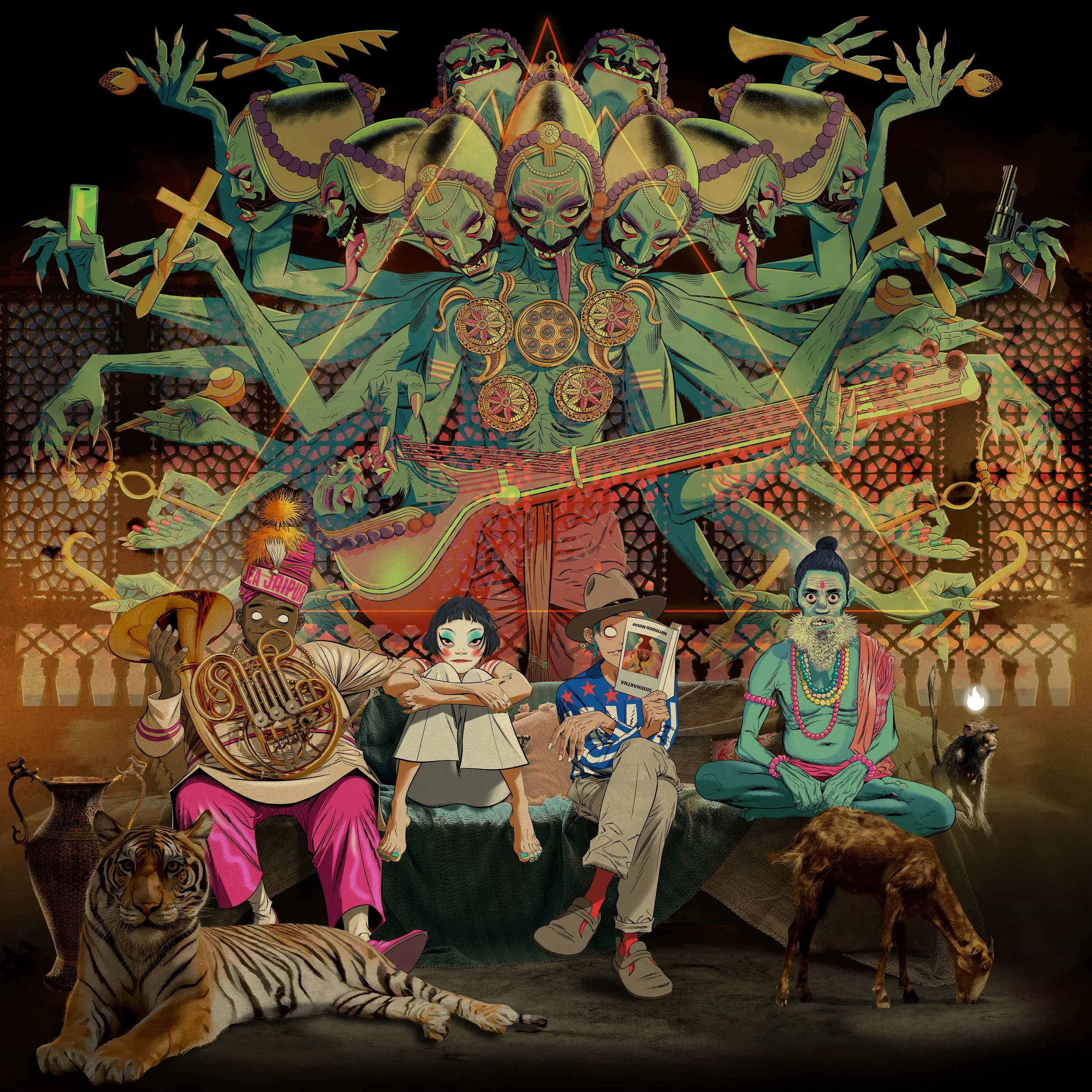
Hewlett’s vibrant illustrations for the record reflect this sense of hopeful community, an integral part of facing loss and grief. His most intricate, detailed and complex artwork for Gorillaz emblazons the album cover and other hand-drawn images depicting the band working on The Mountain in India.
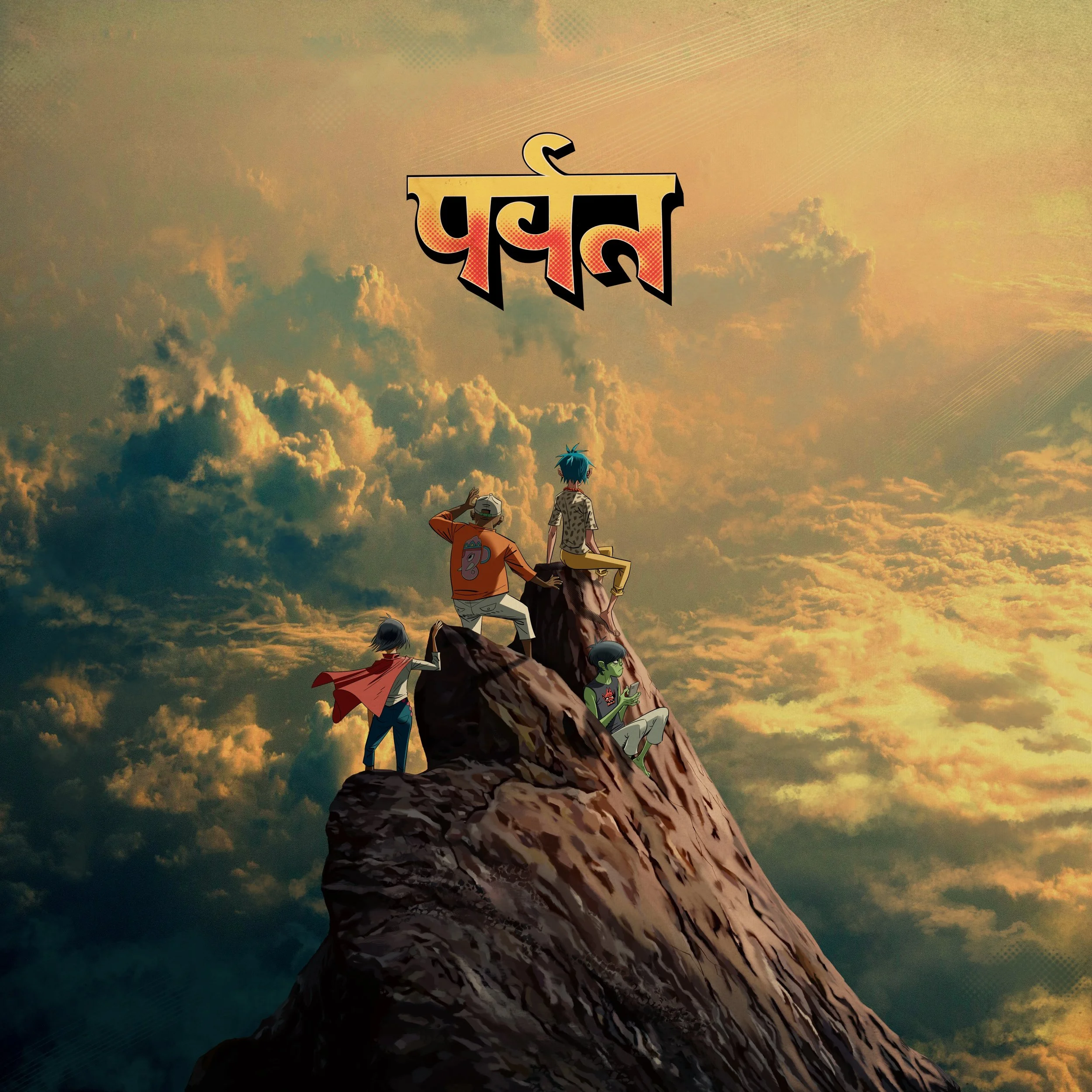
Hewlett also directed the short animated film ‘The Mountain, The Moon Cave and The Sad God’, exploring Gorillaz’ journey across the Indian subcontinent and beyond. After the band fled their LA HQ, picked up fake passports in New York and fled for Mumbai following the events of Cracker Island, the film opens in true Jungle Book style with a red-caped noodle traversing the jungle canopy. As she walks past a billboard for a ‘Plastic Guru’ selling snake oil, Ajay Prasanna’s bansuri comes alive on the album’s opening track. Climbing the bones of a not-so-fossilized dragon, Noodle’s thrown off into a lake, where after swimming ashore and stealing some clothes from a bathing bansuri player, she finds 2-D, Murdoch and Russel. Together they embark on a journey to reach the peak of the mountain, and ‘To The Moon Cave’ begins to play, with 2-D joyfully singing along as the creatures of the jungle watch – or in one snake’s case, attempt to sabotage – the strange four-piece’s pilgrimage.
Reaching the end of their ascent into the head of a giant Hindu deity statue, the moon cave is revealed as a glimmering cavern with walls adorned by azure cave-paintings of all shapes and sizes. Met by a frilled bird with the grand melismas of Jalen Ngonda, the drawings begin falling from the walls as hunter-gatherers, tanks, pyramids and every manner of creature, leading the band towards an underground stream. Joining them is the late Dave Jolicoeur of De La Soul fame, who co-wrote and featured on ‘Feel Good Inc.’ two decades ago. Jolicoeur’s booming words interlock masterfully with the slick bars of Black Thought, lead MC of The Roots, who also laid down verses on ‘The Empty Dream Machine’ and ‘The Sad God’ elsewhere on the album.
Stepping onto a mysterious boatman’s canoe, they leave the cave for the serenity of a lake lined by colossal statues of Hindu gods. Mouthing “I Love You”, Noodle first takes the plunge into the open water, followed by 2-D, Russel and finally Murdoc. The stately album closer ‘The Sad God’ begins to play as each bandmember drifts deeper into the blackness. Listening to the track in full, it’s a lamenting tale of a weary deity defeated by the chaos wrought by human life. “I gave you white sails to reach the sun / I gave you atoms you built a bomb / Now there is nothing and I have gone / No more mountains I have gone” is definitively post-apocalyptic. Albarn’s closing vocals loop “In paradise” with building irony until the meaning of the lyric has all but inverted.
Yet with the film’s final shot depicting a new day dawning on the floating rock we call earth, the dominant emotion is a peaceful hope, not mournful loss. Following the Hindu journey of rebirth, by letting go of their egos and remembering their true self, the bandmembers were reborn.
This is the crux of The Mountain: staring death in the face but emerging with hope and joy for the richness of the world we live in. Speaking of the album, Damon Albarn reflected that maybe some people will leave the album with feelings of lingering darkness, or disjuncture, yet himself, Hewitt and their rollcall of collaborators were actually tapping into the powerful affective power of music for different means.
“The challenge we set ourselves was to make an album about death that made people less afraid of death. Can music really do that? I don’t know if we succeeded but I’ve seen music do the most extraordinary things. But that’s what music does… You pour in the sadness and you sip the light.”
Words by Taran Will